Photo-chemical Redox Process (PRP)
The chemistry involved in our technology is unique, simple, safe and eco-friendly . The PRP has the ability to decompose harmful gases, odor, bacteria, virus etc. into water and non-toxic compounds.
Photo-sensitive Catalyst
Inorganic substance, that can elevate chemical reactions in the presence of light and are not dissipate in the chemical reactions are referred as Photocatalyst. Semi-conductor transition metal oxides are well known examples as photocatalyst.
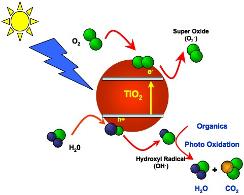
These highly unstable h+ and e- have strong oxidation and reduction power and converts water and oxygen in to reactive oxygen species (ROS) such as hydroxyl radicals (OH.). The uniqueness of ROS is that with its strong oxidizing property
- Decomposes almost all organic pollutants such as toxic volatile compounds that are present in the environment
- Removes air pollutants (NOx, SOx) that are generated by automobiles and industries
- Destroys microbial organisms like E Coli, MRSA which cause infectious diseases
- Decomposes substances such as ammonia (NH3), hydrogen sulphide (H2S), Methylmercaptane (CH3SH), Acetaldehyde (CH3CHO) etc.
Super-hydrophilic Function (SHF)
Another function of the PRP is to make water form a thin sheet on the surfaces that leads to self-cleaning. In the current technology, the surface of a material will repel water to some degree. When water condenses on a substrate such as glass, it forms tiny drops that make the surface difficult to see through and as it dries it leaves dirty water spots behind. The PRP technology is going to modify the surface structure, that will cause droplets to spread out, creating a transparent thin sheet of film. The property of this thin sheet is such that it prevents the formation of droplets that make the surface dirty. Moreover the uniqueness associated with the see through property of this coating is that in the presence of sunlight it helps to break down the dust particles to tiny pieces which can be easily lifted off during the rain or a spray of water.
Mechanism of super-hydrophilic property
The e- in the conduction band has the affinity to reduce the oxidation state of the transition metal to form an intermediate species (B). This lead to liberation of bridge oxygen in the presence of h+ that was present in the valance band to form the species (C). The intermediate species ( C ) has a tendency to dissociate water and adsorb on the surface of the semi-conductor to form the structure (D). Migration of H with the species (D) is taking place in order to form a stable complex (E). The complex E shows superhydrophlic property due to the presence of hydroxyl groups to form a thin film of water on the surface.
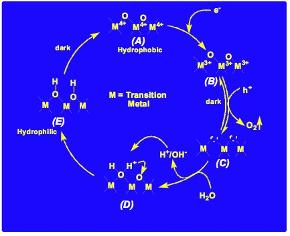 Mechanism of the super hyropillic property
Applications
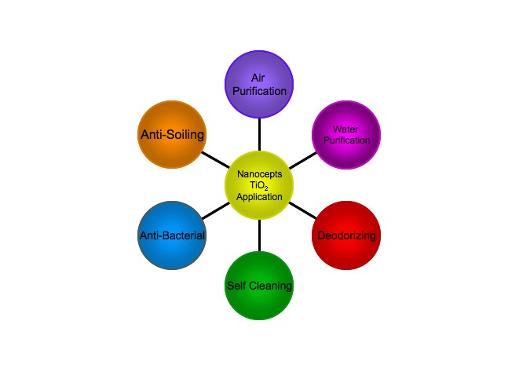
Coating based on Photo-chemical Redox Process has several beneficial applications like
Self-Cleaning
The current problem faced by the property developers and property owners are the deterioration of their buildings due to the pollutants, soot and grime present in the surroundings. Over time, the damage is permanent and the cleaning cost increases. It becomes difficult to maintain the original appearance of the buildings in urban areas. This raises the need for better eco-friendly technology that can help retain the original appearance.

Self-Cleaning Action of Photocatalytic tile
The solution is to coat the surfaces with our Trucoat Nano protective coating products based on the latest technological advanced nano-materials. The proprietary nano- material in the coating prevents the staining of the surface and maintains the original appearance of the buildings. The mechanism behind this technology is the super hydrophilic nature of the coat which forms a very thin sheet of water over the surface. When water forms a thin sheet, it easily lifts the dirt and grime from the surface washing it off effectively. The cleaning effect becomes more efficient, as the coating breaks down the organic pollutant which acts as an adhesive to the dirt and soot which sticks to the surfaces. This cycle of breaking down the pollutants and formation of thin sheet of water will keep the buildings free of stains for years to come. The cleaning property of our coating helps significantly reduce the maintenance costs and minimize the use of toxic cleaning agents.
Anti-Bacterial Effect
Maintaining good hygiene in our homes and places where we work and our overall environment is essential for healthy living. The challenge faced in hospitals and nursing homes is to avoid post secondary infection caused due to an un-hygienic environment. The nano-material in our coating does an effective job of eliminating and preventing the growth of any type of micro-organism such as bacteria, virus, molds and fungi

The nano-particle, in presence of light sources like sun or fluorescent tubes, generates a non-toxic active ingredient which destroys the bacteria, virus, etc. that cause infections. This reduces the need for bleaching and harsh chemicals to keep the place sanitized. The bacteria destroying property of our nano coatings is twice as powerful as that of the current bleaching methods which have lots of drawbacks. One of the drawbacks of the current methods is not being able to prevent the re-growth of the micro-organisms. Scientific studies have shown that the bacteria killed by antibacterial sprays re-grow within a few hours of elimination. The nano-material in our coating works continuously and keeps the environment hygienic and sanitized for years.
Odor / Pollutant Elimination
Bad odor can be caused by various sources which include odour causing micro-organisms or invisible gases present in the environment. Some of these gases are present at unacceptable levels causing long term health problems and un-hygienic environment. Breathing problems are very common in urban areas where pollutants from traffic and factories make it worse. Surfaces coated with products containing the nano-material helps eliminate these harmful gases and odour by converting them into non-toxic compounds and water. The nano-materials act a catalyst making it permanent and efficient in removing the toxic organic and inorganic pollutants present in the atmosphere. The pollutants include, but are not limited to cigarette odor, Nitrogen containing compounds, chlorofluoro carbons (CFC) and sulphur compounds etc.

Water Purification
A photocatalyst coupled with UV lights has tremendous disinfectant properties, too, and can oxidize organic pollutants rendering them into nontoxic materials such as CO 2 and water. This technology is extremely beneficial when eliminating further hazardous organic compounds (TOCs) and killing a variety of bacteria and viruses in secondary wastewater treatment facilities. In pilot programs it has been demonstrated that photocatalytic detoxification systems have been very effective in killing fecal coli bacteria in secondary wastewater treatment facilities.